The Reggio Emilia Approach Explained: Principles, Classrooms and Questions
Alongside Montessori and play-based learning, the Reggio Emilia approach is one of the names parents often come across when they research early education. It is admired around the world for its respect for children's ideas, its beautiful learning spaces and the way it treats art, conversation and projects as serious ways of learning. It is also easy to misunderstand, because Reggio Emilia is not a fixed curriculum or a set of materials you can buy. This guide explains where the Reggio Emilia approach comes from, its core principles, what the famous idea of the hundred languages of children means, what a Reggio inspired classroom looks like and what to ask if a preschool describes itself in these terms.
7 min readAltın Anahtar Eğitim Kurumları
ContentsShow
Where the Reggio Emilia approach comes from
The approach takes its name from Reggio Emilia, a city in northern Italy. After the Second World War, parents in the surrounding villages set out to build new schools for young children, determined that education should help create a more democratic and thoughtful society. The teacher and thinker Loris Malaguzzi joined these efforts and went on to guide the development of the city's municipal preschools and infant-toddler centres for decades.
Over time, the schools of Reggio Emilia attracted international attention, and educators from many countries visited to learn from them. Today, many preschools around the world describe themselves as Reggio inspired, meaning they draw on its ideas while adapting them to their own culture and community.
Core Reggio Emilia principles
Reggio Emilia is best understood as a philosophy rather than a method. Several principles run through it.
The child as capable and curious
Children are seen as strong, competent and full of potential, with their own theories about how the world works. Adults take those ideas seriously rather than seeing children as empty vessels to be filled.
Learning through relationships
Learning is understood as something that happens between people: children with other children, with teachers and with families. Conversation, collaboration and debate are central.
The environment as the third teacher
After adults and other children, the physical space is considered a teacher in its own right. Rooms are designed to invite exploration, encounters and quiet concentration.
Teachers as researchers
Teachers observe, listen, record and reflect on what children are doing and saying, and use what they learn to plan the next steps.
Families as partners
Parents are seen as active participants in their children's education and in the life of the school, not just as recipients of reports.
The hundred languages of children
One of the best-known ideas associated with Reggio Emilia comes from a poem by Loris Malaguzzi, which says that children have a hundred languages, a hundred ways of thinking, playing and speaking, but that school and culture often take ninety-nine of them away. The point is that children express and build understanding in many ways, not only through words and numbers.
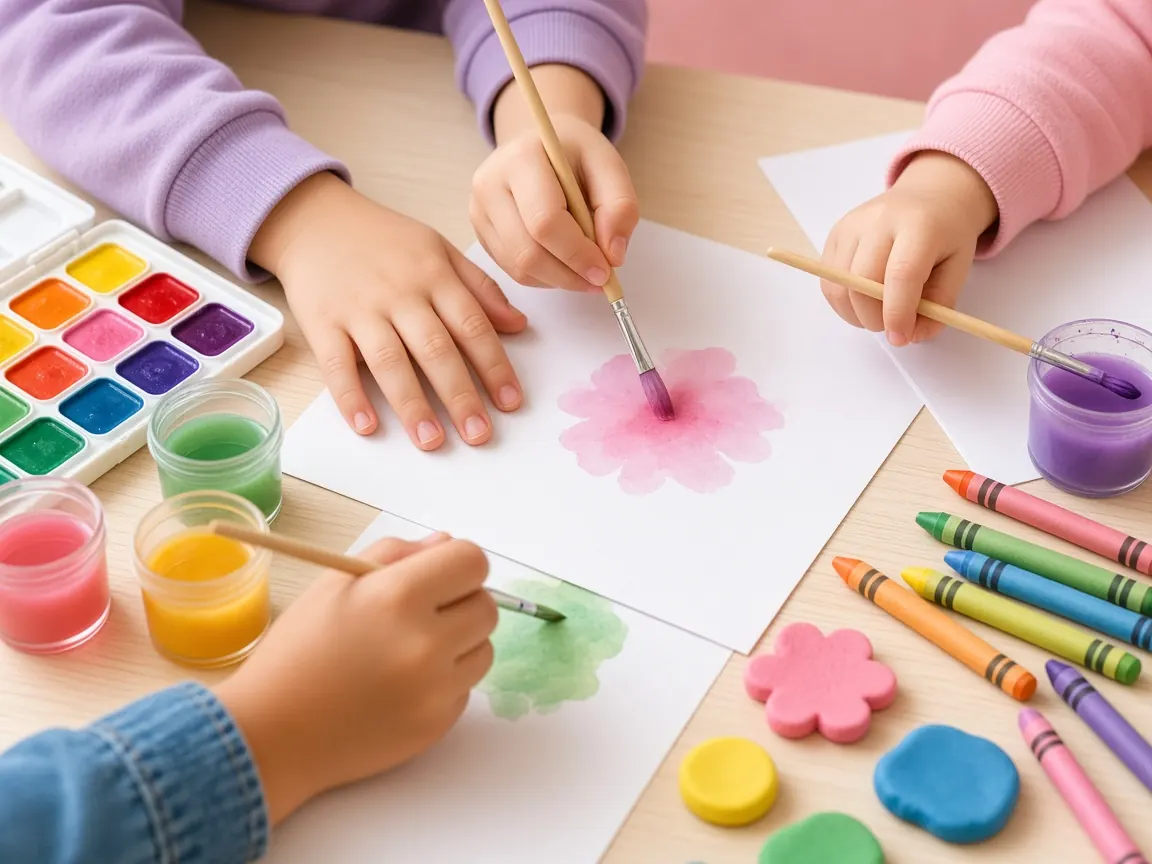
In practice, this means children are encouraged to explore ideas through drawing, painting, clay, construction, movement, music, drama, light and shadow, and conversation. A child investigating how birds fly might draw birds, build a model, act out flight and talk about their theories with friends, each activity deepening their understanding. Our guide to art activities for preschoolers shows how open-ended art can support this kind of thinking at home too.
What a Reggio inspired classroom looks like
Every Reggio inspired setting is different, but visitors often notice some common features.
- Natural light and calm, uncluttered spaces, often with plants, mirrors and natural materials.
- An atelier or art studio, a space for exploring materials, sometimes with a specialist teacher.
- Loose parts: stones, shells, fabric, wood, recycled materials and other objects children can combine in endless ways.
- Documentation on the walls: photographs, children's words and work that tell the story of a project, rather than rows of identical crafts.
- Areas for small-group work, where children can collaborate on a shared investigation.
- Spaces that change as children's interests and projects develop.
Projects and emergent curriculum
Instead of following a fixed timetable of topics, Reggio inspired teachers often develop projects from children's own interests and questions. This is sometimes called an emergent curriculum. A group fascinated by a puddle might spend weeks investigating water, reflections and rain, with teachers offering materials, questions and experiences that stretch their thinking.
Projects can last days or months, and they are carefully planned and supported by adults. Emergent does not mean unplanned; it means the plan grows from close observation of what children are curious about.
The role of documentation
Teachers record children's words, photograph their work and display the process of a project. Documentation helps teachers understand children's thinking, lets children revisit and build on their ideas and shows families what learning looks like day to day.
Strengths and questions to consider
Parents who choose Reggio inspired settings often value the respect for children's ideas, the rich creative experiences and the strong sense of community. Children in these settings frequently get practice at expressing themselves, collaborating and persisting with a question.
There are also things to think about. Because Reggio Emilia is a philosophy rather than a licensed programme, the label can be used very loosely, and the quality of what happens depends heavily on teachers' skills and training. Some parents also want more visible structure or early academic preparation than a project-based approach typically shows. As with any approach, what you see on a visit matters more than the name.
Bringing Reggio ideas home
You do not need a special classroom to borrow some of the spirit of Reggio Emilia. Much of it comes down to how adults listen and what children have access to.
- Take your child's questions seriously and explore them together rather than simply giving the answer.
- Keep a basket of loose parts, such as shells, pine cones, fabric scraps and cardboard, for open-ended play.
- Offer a range of ways to express ideas: drawing, building, modelling, dressing up and storytelling.
- Photograph or write down what your child says about their creations, and look back at it together.
- Follow an interest over days or weeks, visiting the library, going on walks and making things linked to it.
Reggio Emilia, Montessori and play-based learning
All three approaches are child-centred and value hands-on experience, and many preschools blend ideas from more than one. Broadly, Montessori emphasises specially designed materials and independent work, play-based preschools put imaginative and social play at the heart of learning, and Reggio Emilia focuses on projects, relationships, the environment and children's many ways of expressing ideas. Our comparison of Montessori and play-based preschool looks at the first two in more detail.
Questions to ask a preschool
- How do you decide what children will explore, and how are their interests included?
- Can you show me an example of a recent project and how it developed?
- How do teachers observe and record children's learning?
- How are families involved in the life of the school?
- What materials do children have access to every day?
- How do you balance child-led exploration with preparation for primary school?
At Altın Anahtar in Alsancak, we follow a play-based, child-centred approach for children aged 12 months to 6 years, planning activities around children's interests and stage of development. We are not a Reggio Emilia school, though some ideas, such as learning through exploration and hands-on experience, are shared by many child-centred approaches. To see how our day works, you can arrange a visit by appointment.
Frequently asked questions
What is the Reggio Emilia approach in simple terms?
It is an early childhood philosophy from the Italian city of Reggio Emilia that sees children as capable and curious, and builds learning around projects, relationships, a carefully designed environment and many forms of expression.
What does the hundred languages of children mean?
It is an idea from a poem by Loris Malaguzzi: children express and build understanding in many ways, such as drawing, building, movement, music and talk, not only through words and numbers.
Is Reggio Emilia the same as Montessori?
No. Both are child-centred, but Montessori is built around specially designed materials and independent work, while Reggio Emilia focuses on group projects, documentation and the environment as a third teacher.
Is there a Reggio Emilia curriculum?
Not in the sense of a fixed programme. Reggio inspired settings usually follow an emergent curriculum, where projects grow from children's interests and teachers' observations.
Is Altın Anahtar a Reggio Emilia school?
No. Altın Anahtar follows a play-based, child-centred approach. Visits are by appointment if you would like to see how our day works.